

 Key Findings
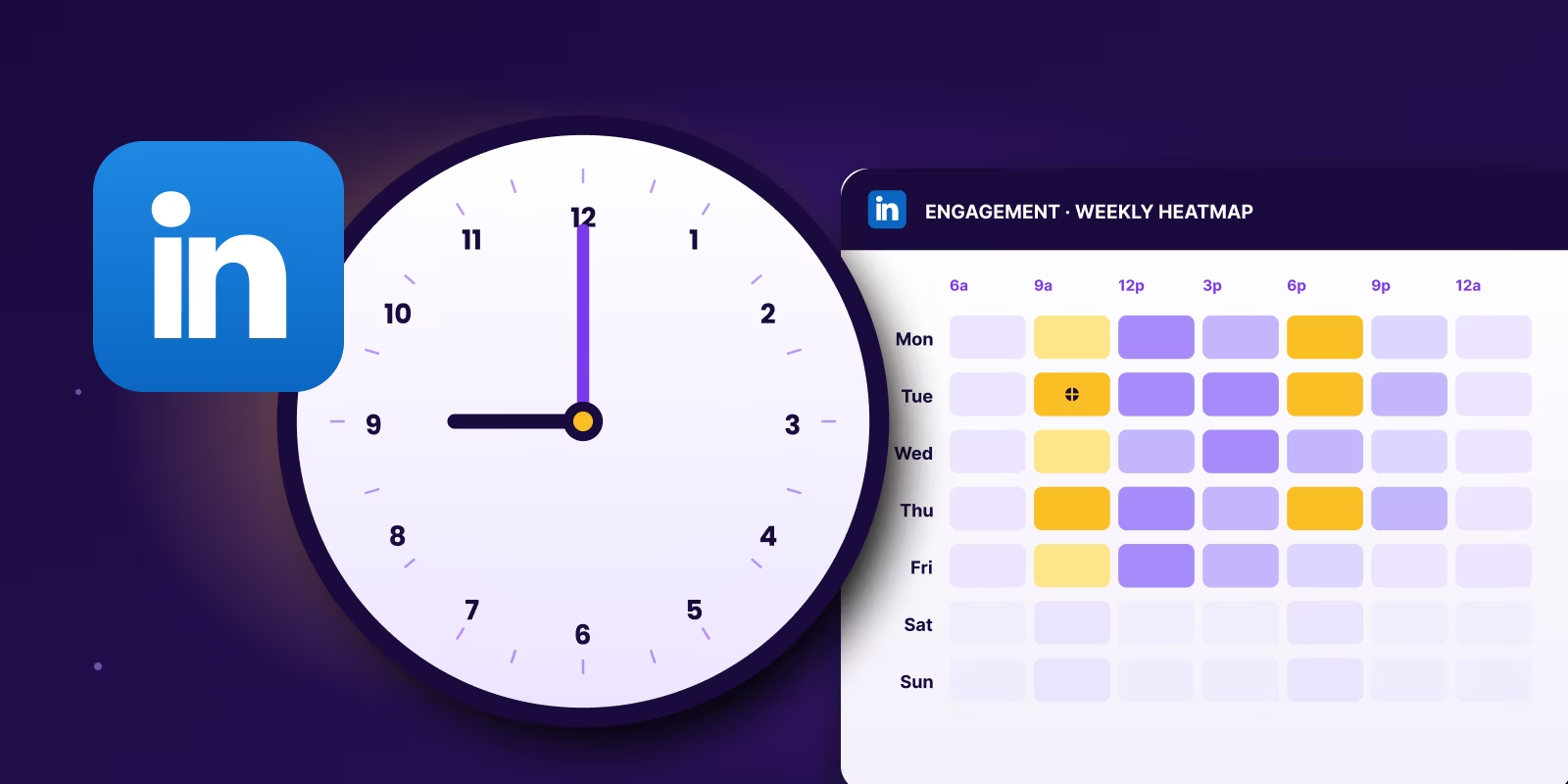
Mid-week mornings outperform the daily average by 30–47% across B2B. Monday warms up slow. Friday drops off after lunch. If you only post twice a week, pick Tue and Thu at 9 AM.
The "best time" is whatever 8–10 AM looks like in their timezone, not yours. Selling to US from APAC means scheduling, not improvising. Local 9 AM beats global "convenient" every time.
The end-of-day scroll is quieter on the supply side, similar on the demand side. Thought-leadership posts that miss the morning slot still pull a 22% CTR lift after 4 PM, especially on Tue and Wed.
B2B engagement drops about 60% on Saturday and Sunday. The algorithm does not hold your post for Monday. Park strong content for Tuesday 9 AM and keep weekends for writing, not publishing.
Posting more than twice a day on the same account drops average reach per post by 35%. Spacing and quality matter more than volume. Anchor one Tuesday post, repurpose into a Thursday comment or short text.
The safest starting point for the best time to post on LinkedIn B2B is Tuesday through Thursday, with the strongest baseline in the 10 AM to 12 PM window in your audience's local time. If you want one day to start with, use Wednesday.
That's the answer many desire. It's also incomplete.
A single “best time” is a nice headline, not a reliable operating rule. If you're running B2B content like a real growth channel, you need a testing system, not recycled advice from articles that pretend every audience behaves the same way.
The Search for the Best LinkedIn Posting Time
Those searching for the best time to post want certainty. They want a clean answer they can plug into Buffer, Hootsuite, or whichever scheduler they use, then move on with their day.
Fair enough. Start with midweek, mid-morning.
But that advice gets lazy fast. It ignores the fact that LinkedIn behavior changes by geography, role, post format, and what you want the post to do. A founder posting a strong opinion for operators in Singapore is playing a different game from a sales team pushing case-study content to buyers across APAC and the US.
That's why generic timing articles usually disappoint. They hand you a time slot, skip the trade-offs, and never explain why one study says midday while another points later in the day. If you've been comparing guides like LinkedIn engagement times 2025, you've already seen how quickly the advice starts to blur together.
What works in practice: treat any published “best time” as a baseline, not a rule.
The useful question isn't “what time should everyone post?” It's “what time gives my audience the highest chance to engage early, keep reading, and start a conversation?”
That answer won't come from a magic hour.
It comes from controlled testing.
Why Most Best Time Advice Is Contradictory
Conflicting timing advice is exactly what you should expect.
Sprout Social reports stronger LinkedIn engagement Tuesday through Thursday around 11 a.m. to 5 p.m. (Sprout Social). Other large studies have pointed to later weekday windows. That gap is not a mistake. It reflects how differently these studies define success, group audiences, and measure post performance over time.
Different studies measure different behavior
One research team may rank posts by raw engagement. Another may weigh clicks, impressions, or engagement rate. Some datasets skew toward social media managers and creators. Others pull in a broader mix of company pages, industries, and content formats.
Those choices change the result.
A post that gets fast likes at 11 a.m. may look like a winner in one study. A post that picks up comments and clicks through the afternoon may win in another. If you want a clearer view of why distribution works this way, this explanation of the LinkedIn algorithm helps.
If you're trying to optimize your social media schedule, start by treating published timing studies as directional guidance, not hard rules.
Audience shape matters more than timing charts admit
A US-based sales tech company targeting VP-level buyers will not behave like an APAC consulting firm speaking to local operators. Time zone is the obvious variable, but it is not the only one.
Role changes behavior. Senior leaders often check LinkedIn between meetings or later in the day, when they finally have room to read. Practitioners may engage in shorter bursts during work hours. Company size also matters. Enterprise buyers and startup operators rarely use the platform the same way.
Generic advice quickly becomes ineffective. A chart that blends every audience into one average can still be accurate at the dataset level and useless for your pipeline.
A timing recommendation without audience context is still a guess.
Content format changes the window
Timing is partly a content distribution problem.
Short opinion posts can perform well in busy scroll periods because the reader can process the point in seconds. Longer educational posts, carousels, and story-led posts often need a calmer window, where people will stop, read, and comment. Studies that combine all formats flatten those differences into one neat answer.
That neat answer is usually too neat to use.
Where B2B teams get this wrong
After reviewing hundreds of posting schedules, the same patterns show up:
- B2B marketing teams test time and content at the same time. They change the topic, format, CTA, and posting hour, then cannot tell what caused the result.
- Teams schedule around internal convenience. Posts go live when the marketer is online, not when the buyer is active.
- RevOps and demand gen teams overread one post. A weak result on Wednesday does not mean Wednesday is a bad day.
- Teams chase minute-level precision too early. Daypart, audience fit, and post quality usually matter more than whether you publish at 10:07 or 10:22.
The contradiction in timing advice comes from aggregation. Studies average together different audiences, goals, and post types, then publish a simple answer readers want to believe. For B2B teams, the useful move is to use that answer as a starting point and then prove or disprove it with your own audience.
Your B2B Baseline A Starting Point That Works
You still need a default. Guessing with no baseline is worse than starting with a conservative one.
A widely cited synthesis of LinkedIn timing studies says the safest baseline for B2B posting is Tuesday through Thursday, with engagement peaking in the 10 AM to 12 PM local-time window, and it also notes that Wednesday consistently performs best across major studies while Saturday and Sunday can see a 50 to 70% drop in engagement compared with weekday posts (Kanbox).
That's your starting grid.
Use local time, not your office time
This sounds obvious. Teams still get it wrong all the time.
If your buyers are in Sydney, Singapore, Bangkok, or London, schedule for their workday. LinkedIn is still a work-context platform for most B2B audiences, so a local-time approach matters more than chasing a universal global slot.
Why this window is the safest default
Midweek mornings to midday tend to align with professional attention. People are into their day, but not fully buried yet. They're checking updates, catching up on ideas, and more open to engaging with something useful.
That doesn't mean every B2B audience behaves identically. It means this is the least risky place to begin if you want a repeatable test.
Baseline rule: If you don't have your own posting data yet, start with Tuesday, Wednesday, and Thursday in your audience's local morning to midday window.
There's another reason this baseline works. It keeps you away from the weakest ground. Weekend posting usually looks attractive only to people who want an empty calendar slot. For most B2B teams, that's a bad trade.
A simple starting schedule
Use this before you get fancy:
| Day | First test window | Why it is useful |
|---|---|---|
| Tuesday | Mid-morning to midday | Good for practical or educational posts |
| Wednesday | Mid-morning to midday | Strongest default day across major studies |
| Thursday | Mid-morning to midday | Good follow-through day if Wednesday performs |
If your team wants a broader LinkedIn motion tied to pipeline, not just content cadence, this walkthrough on how to generate B2B leads on LinkedIn connects posting with actual outbound use cases.
Don't treat this baseline like doctrine. Treat it like a clean starting point that gives your test a fair shot.
How to Find Your Actual Best Time in 4 Weeks
Many articles typically stop at this point. They give you a few times, toss in a chart, and leave you with no method.
That's useless.
Week 1:Morning focus
Post Mon to Fri at 9 AM
Week 2:Midday check-in
Post Mon to Fri at 12 PM
Week 3:Afternoon reach
Post Mon to Fri at 3 PM
Week 4:Analyze and validate
Review engagement data to pinpoint your audience's peak times
A practical B2B posting approach is to treat Tuesday through Thursday, especially 7:00 to 9:00 AM local time, as the initial test window, and to run timing as a controlled experiment by keeping audience, content format, and time zone constant for at least 4 to 6 weeks (Hashmeta).
The rule that matters most
Change one variable at a time.
If you change topic, structure, author voice, CTA, and posting hour all at once, your data is garbage. You won't know whether the post won because of timing or because the content was better.
A clean 4-week test
Keep the audience, format, and posting days stable. Only change the hour.
Use something simple like this:
- Week 1: Post on Tuesday, Wednesday, and Thursday at 9 AM local time.
- Week 2: Post on Tuesday, Wednesday, and Thursday at 12 PM local time.
- Week 3: Post on Tuesday, Wednesday, and Thursday at 3 PM local time.
- Week 4: Repeat the strongest slot from the first three weeks and validate it.
This isn't about finding a perfect minute. It's about identifying the time band your audience responds to most consistently.
Keep these controls tight
The tighter your controls, the cleaner your answer.
- Content format stays fixed. If week one is text-only, don't switch week two to a PDF carousel.
- Audience stays fixed. Don't aim one post at founders and the next at HR leaders.
- Time zone stays fixed. Choose the buyer's local zone and stick to it.
- Posting days stay fixed. Don't test Tuesday one week and Friday the next if your main goal is timing.
Post quality still needs to be solid. Controlled testing doesn't rescue weak content.
What to track
You do not need a fancy BI setup for this. A spreadsheet works.
Track two buckets separately:
- First-hour engagement
- Total engagement after a longer window
That second bucket matters because some posts start slow and keep spreading later. If you judge too early, you'll kill posts that had legs.
Use a table like this:
| Date | Day | Time | Format | Topic | First-hour engagement | Total later engagement | Notes |
|---|---|---|---|---|---|---|---|
Keep the notes column honest. Did employees engage early? Did the post get strong comments from buyers? Was the hook stronger than usual? Context matters.
How to read the results without fooling yourself
Don't crown a winner from one outlier.
Look for patterns across the month. If a slot consistently gets stronger early interaction and better total engagement, that's useful. If one post exploded because the topic was unusually sharp, that's not a timing lesson.
Also, split your goals mentally:
- If you want comments and conversation, a later slot may outperform.
- If you want workday visibility with professional audiences, mid-morning may stay stronger.
- If you want profile visits or inbound DMs, check which slot creates the right downstream behavior, not just surface engagement.
What usually ruins the experiment
A few common errors will waste the whole month:
- Posting inconsistently. If you skip half the test days, you don't have enough signal.
- Using different writers. Voice and hooks change more than people admit.
- Letting one strong topic bias the read. Great content can distort the timing comparison.
- Judging by likes only. A post with fewer likes but stronger comments from the right people can be the better result.
If you've been asking for the best time to post on LinkedIn B2B, this is the only answer that scales. Start with published baselines, then build your own schedule from controlled evidence.
Forget Timing If Your Content Is Wrong
A weak post at the "right" time still gets ignored.
That is the part a lot of LinkedIn timing advice skips. Teams spend hours debating Tuesday at 10 AM versus Thursday at 11 AM, then publish a post with no point of view, no specificity, and no reason for a buyer to stop scrolling. The schedule gets blamed. The post was the problem.
Good timing increases the reach of a strong post. It does very little for generic content.
What good B2B LinkedIn content actually does
The best B2B posts earn attention fast because they create a clear reaction. In practice, that usually means one of four things:
- They take a real position. A useful post says something a competent buyer can agree or disagree with.
- They teach from actual reps. A lesson from a live campaign, sales call, hiring miss, or pipeline review beats recycled advice.
- They include specifics. Numbers, constraints, examples, and trade-offs make the post feel earned.
- They give the right people something to respond to. Good comments do not happen by accident. The post needs tension, a lesson, or a decision point.
A concrete example helps. Compare "Consistency matters on LinkedIn" with "Our outbound team cut executive posting from 5 days a week to 3 and got better buyer comments because each post had a sharper point." The second one gives the reader something useful to test, question, or apply.
What gets ignored
Low-performing B2B posts usually share the same problems.
They sound polished but empty. They summarize familiar ideas without adding evidence or experience. They aim so broadly that nobody in the target audience feels addressed. A vague post does not become persuasive because it went live mid-morning.
If your post says what every other founder, SDR leader, or agency says this week, timing will not rescue it.
Distribution still matters after you publish
The first hour is not just a timing variable. It is an engagement window you can influence.
Reply to comments quickly. Ask a follow-up when someone shares an opinion. Send the post to a few coworkers or customers only if they are likely to add real substance, not vanity likes. Early discussion helps the post travel because LinkedIn rewards activity, but empty engagement can also create the wrong signal if the people interacting are not your buyers.
That trade-off matters. I would rather see 8 comments from sales leaders, operators, or founders in the ICP than 40 likes from peers with no buying intent.
If your team has solid ideas but the posts come out flat, a LinkedIn ghostwriting service can help turn real operator insight into publishable content without sanding off the voice.
If video is part of your content mix, ProdShort's complete 2026 guide is useful for getting the format right. Format problems and timing problems often get confused.
Timing helps distribution. Content drives response. In B2B, response is the part that leads somewhere.
Stop Guessing and Start Building a System
The best posting time isn't a fixed answer you discover once and keep forever. User behavior shifts. Platform behavior shifts. Your audience shifts too.
That's why the key advantage isn't finding one magic slot. It's building a process that notices when the old slot stops working.
A good operator treats LinkedIn timing the same way they treat outbound messaging. Start with a sensible baseline. Test one variable at a time. Watch the signal. Keep what wins. Kill what doesn't.
That mindset travels well across channels. If you're publishing more video and need a practical reference for format execution, ProdShort's complete 2026 guide is a useful companion to timing tests because posting mechanics and posting windows often get mixed together.
Don't chase certainty. Build a better feedback loop.
That's how you get a posting schedule that fits your buyers instead of some generic chart written for everyone and no one.
Vivian Ger runs this four-week test for Reachly clients as part of the content system.
Recommended service
LinkedIn Ghostwriting
Reachly writes and runs your LinkedIn presence so your profile builds authority and brings in inbound B2B leads.