

Outbound lead generation means you start the conversation: you pick the accounts, the timing and the message, rather than waiting to be found. Built properly it is a system with six steps and a measurable output, and Reachly campaigns produce first qualified meetings in weeks 5 to 7 with 10 to 40 interested leads a month once volume settles. This guide covers the whole build: targeting, signals, sequence, copy, infrastructure and the numbers to watch.
TL;DR: Summary
- Outbound is a system, not a campaign: ICP, enriched list, signals, copy, multichannel sequence, reply handling.
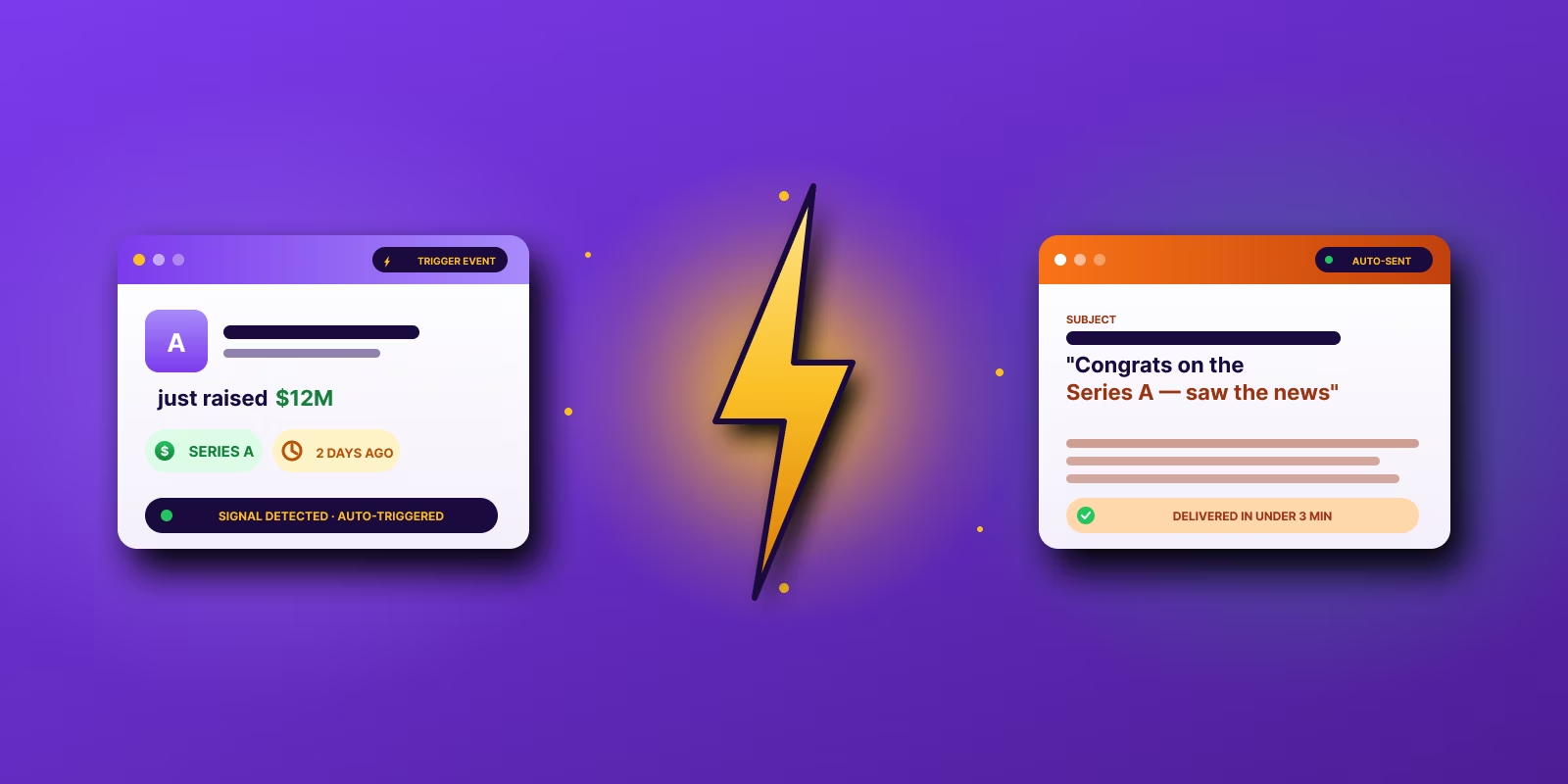
- Signals decide timing. A message sent 48 hours after a funding round or a relevant LinkedIn post lands differently from the same message sent on a schedule.
- Run cold email, LinkedIn and cold calling against one account list over 10 to 14 days, with replies pulling contacts out automatically.
- Keep the first email under 50 words: one signal, one problem, one question.
- Send from dedicated domains, three mailboxes each, 30 sends a day, two verification passes on every address.
- Watch positive reply rate, meetings booked and bounce rate. Open rate stopped being reliable after mail privacy protection.
- Reachly runs the whole motion from $3,500 a month. See outbound lead generation services.
What is outbound lead generation?
Outbound lead generation is the practice of identifying the companies and people who fit your ICP and contacting them directly, through cold email, LinkedIn and phone, before they have raised their hand. Inbound captures demand that already exists. Outbound reaches the accounts you chose, on the timeline you chose.
What outbound gives you that inbound cannot
Control over three variables. You choose the market, the account list and the moment. That matters most in three situations: launching a product nobody is searching for yet, entering a country or vertical where you have no brand, and selling to named enterprise accounts that will never arrive through search.
It also makes forecasting possible. Once you know what a given number of contacts in a given segment produces in replies and meetings, pipeline becomes arithmetic rather than hope. Reaching that point takes about three months of consistent sending.
Where outbound is the wrong tool
Outbound struggles when the ICP cannot be listed, when the offer has no clear before and after, and when nobody owns reply handling. A campaign that lands 40 replies and answers them four days later produces almost nothing. If you cannot staff the inbox daily, fix that before buying more contacts.
How is outbound different from inbound?
Both produce leads. They differ on speed, control and what happens when you stop. The strongest B2B teams run both, with outbound carrying the quarter and inbound compounding underneath it. We cover the split in more detail in our guide to how inbound and outbound work together.
| Factor | Outbound | Inbound |
|---|---|---|
| Speed to first meeting | Days to weeks | Months |
| Predictability | High once the system is calibrated | Depends on search and algorithm changes |
| ICP control | You choose every account | Whoever finds you |
| New market entry | Works immediately | Slow, needs local search volume |
| What happens if you stop | Pipeline stops within weeks | Traffic decays over months |
| Main ongoing cost | Infrastructure, data and reply handling | Content production and links |
What are the six steps of an outbound system?
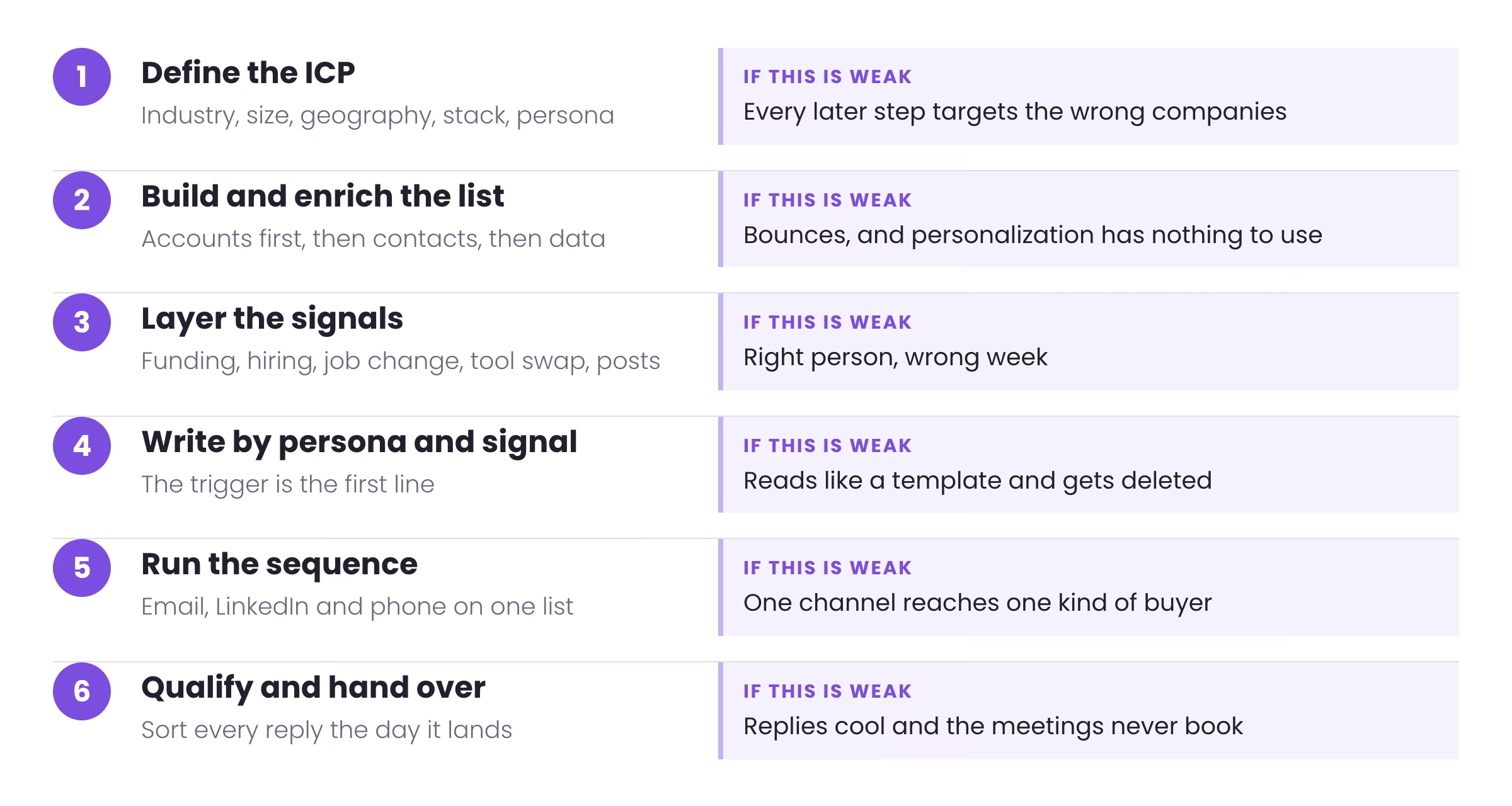
Outbound fails at the weakest link, not on average. Each step below feeds the next, and skipping one shows up two steps later as a low reply rate that copy edits will not fix.
1. Define the ICP narrowly enough to exclude people
SaaS companies with 50 to 500 employees is a category, not an ICP. A working definition names industry, headcount, geography, tech stack, growth stage and the persona inside the buying committee. Everything downstream inherits this decision, so it is worth a week.
2. Build the account list, then the contacts
Accounts first, people second. Apollo builds the initial list from ICP filters, then every record goes through Clay for enrichment: funding, headcount change, job postings, tech stack, recent LinkedIn activity. The full table build is in our Clay workflow guide.
3. Layer the buying signals on top
The list says who. Signals say when. Trigify and Clay monitor the triggers continuously, and a contact enters the sequence when one fires rather than when a batch is ready.
4. Write copy per persona and per signal
The signal is the first line. A company that just entered a new APAC market gets a different opener from one that closed a Series B last week. Write modular frameworks by persona and signal type, then assemble with enrichment variables so personalization survives volume.
5. Build the sequence across channels
Email through Smartlead, LinkedIn through HeyReach, calls on the accounts worth a dial. Touches are coordinated against one account list, and a reply on any channel exits the contact from all of them.
6. Qualify replies and hand over
A reply is not a meeting. Someone asking for more information still needs qualifying before they reach a closer. Categorize every reply the day it lands, answer the question, then move to the ask. Everything that is not a fit goes back into nurture with a date on it.
Which buying signals should you monitor?
Signals divide into company-level triggers, which tell you an account is moving, and person-level triggers, which tell you an individual is thinking about the problem this week. Person-level signals decay fastest, usually inside a week, so they need automation rather than a weekly review.
| Signal | What it tells you | How to use it |
|---|---|---|
| Funding round | Budget released and growth targets moved | Reach out inside 72 hours on GTM readiness |
| Sales or marketing hiring spike | The team is scaling and process is behind | Capacity and ramp angle to the VP of Sales |
| New leadership hire | Fresh authority inside a first 90 days | Reach out before the stack is decided |
| Job change at a target account | A known contact now has budget somewhere else | Congratulate, then reopen the old conversation |
| Market expansion | New geography with no pipeline | Local network and market knowledge as the hook |
| LinkedIn post about a pain | They are thinking about it this week | Reference the post, add one view, ask |
| Engagement on a competitor's content | Actively researching the category | Lead with the comparison they are already making |
| New tool adopted | A platform next to yours just went in | Integration angle or the gap it leaves |
| Tool churned | They are in evaluation mode | Position as the replacement, lead with migration |
| Headcount growth above 20% in six months | Process is breaking somewhere | Operational strain angle, not features |
| Site visit, deanonymized | They already know who you are | Match the message to the page, same day |
| Award or funding milestone | A positive moment, receptive to contact | Open on the milestone, connect it to the offer |
Set these up once inside Clay and they run continuously: a trigger fires, the contact is enriched with the context of that specific signal, and the sequence that goes out references it. Our buying signals guide covers sourcing and decay per signal type.
What does the sequence look like day by day?
Ten to fourteen days, five to seven touches, three channels. Most meetings come from touch three to five, so a single email is not a test of anything. Each touch carries a new angle rather than a reminder that the last one went unanswered.
| Day | Channel | Touch |
|---|---|---|
| 1 | Profile visit and connection request with one line of context | |
| 1 | Cold email | Signal-triggered opener, three or four sentences, one low-friction ask |
| 3 | Cold email | Second angle, different value point, still short |
| 5 | LinkedIn or email | Message if connected, third email if not |
| 8 | Cold email | One-sentence check, direct |
| 12 | Phone | Call on the accounts worth a dial, referencing the earlier touches |
| 14 | Cold email | Close the loop and offer the opt-out |
Every touch is logged, and a reply anywhere exits the contact from the whole sequence. The LinkedIn half of this is covered in more depth in our LinkedIn lead generation playbook, and the fifteen plays that feed the top of this sequence are in our B2B lead generation strategies guide.
How long should a cold outbound email be?
Under 50 words for the first touch. The reader is scanning on a phone, and every sentence that is not the signal, the problem or the question is a reason to stop reading. The goal of email one is a reply, not a booking.
Ninety-four words that say nothing
Hi John,

I'm reaching out because my company has developed an AI-powered
platform designed to help businesses like yours improve their
operational efficiency. Our solution automates workflows, gives
teams actionable data, and changes how you approach project
management. We've helped many companies in the tech space and I
believe we could provide significant value to your team.

Would you be available for a 30-minute call next week to explore
how we can help you achieve your goals?
Thirty-nine words that earn a reply
Hi John,

Saw your team just raised a Series B. Usually when that happens,
finance gets buried in new compliance paperwork inside a month.

We automate that part, and clients get back about 10 hours a week.

Open to a look?
The second version names a trigger, connects it to a problem the reader recognizes, gives one number, and asks a question that can be answered with one word. Subject lines, follow-up angles and length tests are covered in the cold email playbook.
What does the tool stack need to cover?
Tools are not the strategy, but each of these covers a step that otherwise becomes manual work nobody keeps up. This is the stack Reachly runs on every client campaign.
| Tool | Job | Why it is in the stack |
|---|---|---|
| Apollo | Prospecting | Builds the first account and contact list from ICP filters |
| Clay | Enrichment | Pulls live company and person data and feeds it into copy variables |
| Trigify | Signals | Monitors LinkedIn activity, job changes and engagement triggers |
| Icypeas | Email discovery | Waterfall finder for contacts other sources miss |
| LeadMagic | Verification | Validates addresses before anything enters a sequence |
| Zapmail | Domain infrastructure | Spins up and manages dedicated sending domains and mailboxes |
| Smartlead | Cold email | Inbox rotation, warm-up, deliverability monitoring, reply routing |
| HeyReach | Profile visits, requests and messages across several accounts, synced to the email sequence |
The comparison of alternatives at each step is in our B2B lead generation tools guide.
How do you protect deliverability while sending volume?
Sending volume from the company domain risks the address every invoice and support reply comes from. Every Reachly campaign sends from dedicated domains that sit beside the client's brand domain, so a reputation problem stays in the outbound system.
| Rule | The number | Why it is there |
|---|---|---|
| Dedicated sending domains | Never the brand domain | Keeps a reputation hit away from company mail |
| Mailboxes per domain | 3 | More than that reads as bulk sending |
| Warm-up before first campaign | 2 to 4 weeks | New domains have no sending history to trade on |
| Sends per inbox per day | 30 | Consistent with a person, not a broadcast |
| Verification passes per address | 2 | One provider misses what the other catches |
| Bounce rate ceiling | 3% | Above this, pause the domain the same day |
| Authentication | SPF, DKIM and DMARC on every domain | Without all three, placement drops regardless of copy |
The ramp schedule and how long a new domain needs before it carries real volume are in our email warm-up guide.
What happens between a reply and a booked meeting?
Getting a positive reply is the halfway point. The gap between a reply and a meeting is where most outbound programs lose their output, and the cause is almost always delay rather than wording.
Answer the same day, in the same thread
Interest decays in hours. A reply that waits two days gets answered by someone who has moved on to the next priority. Assign the inbox to one person with a daily slot rather than to whoever notices first.
Qualify before the calendar, not on the call
Read the intent behind the words. A request for pricing and a polite brush-off can look similar in one line. Answer the actual question, then move to the ask in the same message rather than trading four emails first.
Make booking one click
Send the calendar link with the answer and book straight onto the closer's calendar. Every extra step between interest and a confirmed slot costs meetings that were already won.
Should you build outbound in-house or hire it out?
Both work. They fail differently. In-house gives you control and keeps the learning inside the company, and it costs a salary plus the stack plus three to six months before a new hire is productive. An agency starts with the infrastructure already warm and the process already written, and the learning sits partly outside your team.
| Factor | In-house SDR team | Managed service |
|---|---|---|
| Time to first meeting | 3 to 6 months including hiring and ramp | Weeks 5 to 7 from kickoff |
| Cost shape | Salary, benefits, management time, plus the tool stack | One monthly retainer, from $3,500 with Reachly |
| Infrastructure | You buy domains, warm them and monitor placement | Already built and warm |
| Control | Full, including the daily priorities | Set through ICP, messaging approval and reporting |
| Risk when someone leaves | The motion pauses | Covered by the provider |
| Where the learning lives | Inside your team permanently | Shared, and partly with the provider |
The line-by-line cost comparison is in our breakdown of what a lead generation agency costs.
How do you measure outbound lead generation?
Six numbers, checked weekly. The first three tell you whether the targeting and message are right. The last three tell you whether the infrastructure is healthy enough for any of it to matter.
| Metric | What it measures | Working range | If it is low, check |
|---|---|---|---|
| Reply rate | List fit and message relevance | 5 to 15% | Segmentation and offer, before the copy |
| Positive reply rate | Whether you named a real problem | 2 to 8% | ICP quality and the angle |
| Meeting booked rate | Ask size and reply speed | 1 to 4% | How fast replies are answered |
| Bounce rate | List quality and verification | Below 3% | Verification passes before import |
| Spam complaint rate | Infrastructure health | Below 0.1% | List hygiene, volume per inbox, domain age |
| Cost per meeting | Whether the economics work | Varies by ICP | Channel mix before cutting spend |
The feedback loop that matters runs between reply rate and targeting. Clean deliverability with low replies is a list problem or a timing problem, and rewriting the email will not move it.
What is different about outbound in APAC?
APAC is not one market. A campaign that works in Singapore does not transfer to Japan unchanged, and the parts that break are rarely the product claims. Five things get localized on every campaign we run.
- Send timing, against local working hours and the local holiday calendar.
- Tone, direct in Singapore and Australia, relationship-first in Japan and Vietnam.
- Offer framing, against what the regional market treats as the priority this year.
- Channel weighting, because LinkedIn penetration varies widely across the region.
- Follow-up cadence, against local norms on persistence.
Inbox competition across most APAC markets is still lower than in the US and Europe, which is why a well-run campaign here tends to outperform the same campaign run into a Western inbox.
What does a built outbound system produce?
Two client programs, both published as case studies.
| Client | What we built | Result |
|---|---|---|
| Primal, marketing services, Thailand | ICP tightened to mid-market APAC companies with active marketing spend, enrichment through Clay, signal triggers on growth events | 85+ SQLs in 6 months, 6 deals closed, 35% lower CAC, 4.57x ROI, 8% positive reply rate |
| The Great Room, premium co-working, Singapore and Australia | Account-based campaigns on companies expanding into new APAC markets, cold email and LinkedIn combined, SDR-led nurturing | $250K+ in closed contract value in about 9 months, meetings up from around 2 a quarter to around 2 a month |
Full write-ups: Primal and The Great Room.
Outbound, built and run for you
Reachly maps the TAM, builds the signal layer, warms the infrastructure, runs cold email, LinkedIn and calling, and books qualified meetings on your calendar. One flat retainer from $3,500 a month, first meetings in weeks 5 to 7.
See how it works
Outbound lead generation FAQs
What is outbound lead generation?
Outbound lead generation is contacting the companies and people who match your ICP directly, through cold email, LinkedIn and phone, instead of waiting for them to find you. It covers targeting, signal monitoring, sequencing, copy and reply handling, and its output is booked meetings.
What is signal-based outbound?
Reaching out only when a trigger makes the message relevant: a funding round, a leadership hire, a hiring spike, a post about the problem you solve, a tool added or dropped. The timing carries the relevance that copy alone cannot.
How is outbound different from inbound lead generation?
Inbound captures demand that already exists through search, content and referral. Outbound creates the conversation with accounts you chose. Outbound is faster to first meeting and stops when you stop; inbound is slower and compounds.
How many touches does it take to book a meeting?
Most meetings come from touch three to five. A working sequence runs five to seven touches across email, LinkedIn and phone over 10 to 14 days, with each touch adding an angle rather than repeating the last one.
How long does outbound take to produce meetings?
Weeks 1 to 4 cover ICP work, domain setup and warm-up. Campaigns launch around week 4 and first qualified meetings usually land in weeks 5 to 7, with volume becoming predictable around month 3.
How long should a cold email be?
Under 50 words for the first touch. One signal, one problem, one question. Longer emails get scanned and closed, and the first email only needs to earn a reply, not a booking.
How many emails a day can one mailbox send?
Thirty. Beyond that the pattern stops looking like a person. Scale by adding mailboxes and domains rather than by raising the per-inbox number, and warm each new mailbox for two to four weeks first.
What bounce rate is acceptable in outbound?
Below 3%, and the fix is verification rather than tolerance. Run every address through two providers before import, and pause a domain the day it crosses the line rather than at the end of the campaign.
Do you need dedicated domains for cold email?
Yes. Sending campaign volume from the company's main domain puts invoices, support mail and everything else at risk if placement drops. Dedicated domains keep any reputation damage inside the outbound system.
Is cold calling still part of outbound?
Yes, positioned late in the sequence. A call on day 12, after two emails and a LinkedIn touch, reaches someone who recognizes the name. Calling a list with no prior context is a different and much harder job.
Should you run outbound in-house or hire an agency?
In-house keeps the learning and control, and costs a salary plus the stack plus three to six months of ramp. A managed service starts with warm infrastructure and a written process. The deciding question is usually whether anyone can own the inbox every day.
What does outbound lead generation cost?
Self-run, the infrastructure and data sit in the low hundreds of dollars a month before anyone's time. Managed, Reachly charges one flat retainer from $3,500 a month covering the whole stack, the sending and reply management.
How does Reachly run outbound lead generation?
Reachly maps the TAM across multiple data sources, enriches accounts with intent signals such as headcount growth and funding, runs multichannel campaigns over cold email, LinkedIn and phone from dedicated sending domains, then manages replies, nurturing and meeting booking with live reporting.
Recommended service
Outbound Lead Generation Services
Reachly builds and runs the whole outbound motion across email, LinkedIn, and phone, and books qualified meetings on your calendar.