A Modern Guide to Segmentation for B2B

A modern guide to B2B segmentation: how to break down your total addressable market into precise segments based on firmographics, technographics, and buying signals so your outbound campaigns reach the right people at the right time, with messaging that actually converts.

By
Thibault Garcia
19/3/26
Key Findings

Outbound lead generation gives you control that inbound never can. You choose the market, the company size, the job title, and the timing. That level of precision is what turns outbound into a predictable revenue engine instead of a guessing game.

Signal-based targeting is the difference between relevant outreach and random noise. Buying signals like funding rounds, hiring activity, and tech stack changes tell you which companies have a problem right now, not just which ones might have a problem someday.

A multichannel sequence across cold email, LinkedIn, and cold calling dramatically outperforms single-channel outreach. 70% of reps quit after one email. The meetings are sitting in the follow-up touches that most people never send.

Deliverability is not optional. Never send cold outreach from your primary domain. Dedicated sending domains, proper DMARC/SPF/DKIM setup, and verified contact lists are the non-negotiable foundation of any outbound program that actually lands in the inbox.

The only metrics worth tracking are positive reply rate, meeting booked rate, and pipeline value generated. Open rates are unreliable and do not move deals forward. If your positive reply rate is below 1%, fix your targeting or your messaging before you scale anything.

If your outreach gets ignored, don't blame your SDRs. Look at your segmentation. Most B2B companies group accounts by industry and employee count. That tells you nothing about whether they need your product right now. The real key to segmentation for B2B is timing and intent, not just static company data.

Why Your Current B2B Segmentation Is Broken

We see this mistake constantly. Companies treat a 100-person firm that just raised a Series B the same as a 100-person legacy business with flat growth. Then they wonder why they get ghosted. The problem is not that you need more leads.

You need the right leads at the right time.

Poor segmentation costs you money and momentum. It leads directly to:

  • Wasted ad spend: You are burning cash on companies that have no budget or immediate need.
  • Burnt-out sales teams: Your SDRs get demoralized calling accounts that were never going to convert.
  • Damaged domain reputation: Sending a firehose of irrelevant emails gets you marked as spam, killing your deliverability.

This is not a theory. It is what we see every day when we fix broken outbound funnels for clients at Reachly. Smart segmentation is not about who a company is. It is about what it is doing right now.

"

We see it constantly. A founder comes to us with a list of 5,000 contacts and wonders why nothing is converting. When we dig in, the targeting is based on firmographics alone. No signals, no timing, no context. We rebuild the segmentation around what is actually happening at those companies right now and the reply rates change completely.

Thibault Garcia Founder of Reachly

The Data Does Not Lie

In a B2B market projected to hit $32.11 trillion by 2025, you cannot afford to be generic. The numbers prove precision pays off. Segmented email campaigns deliver 30% more opens and 50% more clickthroughs than generic blasts. For founders and sales leaders with an unpredictable pipeline, this is not a nice-to-have. It is the difference between hitting quota and missing it badly.

If you are just starting, you need to understand the core principles. There are great resources that break down the fundamentals, like this piece on What Is Audience Segmentation, which explains how these concepts apply to different business models.

The goal is to move from a wide net to a sharp spear. Instead of blasting your entire market, you target small, specific groups with messages that solve a timely, known problem.

From Vague to Actionable

Think about the difference. A vague segment is "SaaS companies in North America with 50-200 employees." An actionable, high-precision segment is "SaaS companies in North America with 50-200 employees that use HubSpot, just hired their first VP of Sales, and have seen a 30% increase in website traffic over the last three months."

Which group do you think needs help with lead generation?

This guide shows you how to build and act on those specific, intent-driven segments. We will walk through the data sources, tools, and exact workflows you need to stop guessing and start targeting. Of course, before you build a list, you must first understand how to secure quality leads and what makes them valuable.

The Four Tiers of B2B Segmentation Data

Not all data is equal. Countless outbound campaigns fail because teams treat every data point the same, lumping everything into one giant segmentation bucket. That is a recipe for generic outreach.

A better way to approach segmentation for B2B is to think of it as a hierarchy of signals. We break it down into four tiers, each one adding a layer of context. Layering them is how you move from a blurry, mass-market view to a crystal-clear list of high-value targets.

The Four Data Tiers Explained

Think of it like building a house. You cannot put up walls without a solid foundation.

Data Tier What It Tells You Example Tools Impact on Outreach
Tier 1: Foundation Basic company profile (industry, size, tech stack) LinkedIn Sales Navigator, Apollo, BuiltWith Broad targeting to define your total market. Low relevance on its own.
Tier 2: Engagement How accounts interact with your brand Your website analytics, marketing automation platform Helps you spot accounts showing initial curiosity. Warms up the conversation.
Tier 3: Intent Which companies are actively researching solutions now Bombora, G2, news alerts Provides the crucial "why now" for timely, relevant outreach.
Tier 4: Custom Unique triggers specific to your value proposition Custom scripts, Clay, manual research Creates a massive competitive advantage with highly personal outreach.

By layering these tiers, you build an incredibly precise go-to-market motion. You stop guessing and start engaging accounts based on real, actionable intelligence.

Tier 1: Firmographics and Technographics

This is your foundation. The absolute bare minimum you need to know about a company before you reach out. Firmographics tell you who the company is, while technographics tell you what tools they use.

  • Firmographics: Industry, employee count, annual revenue, and location. Your first filter for slicing down your Total Addressable Market (TAM) and weeding out the obvious misfits.
  • Technographics: A company's tech stack. Are they a HubSpot or Salesforce shop? Do they use specific software that integrates with your product? This data is your secret weapon for a relevant opening line.

You can pull this data from tools like LinkedIn Sales Navigator, Apollo, or BuiltWith. But here is the catch: this is just table stakes. Relying only on Tier 1 data is a fast track to the spam folder because it tells you nothing about an account's immediate needs.

Tier 2: Behavioral Signals

This is where things get warmer. Behavioral signals track how companies and specific prospects interact directly with your brand. It is a huge step up from static data because it reflects active engagement.

This includes actions like:

  • Visiting your pricing page
  • Downloading a whitepaper or case study
  • Attending one of your webinars
  • Opening your marketing emails multiple times

These signals show surface-level interest, but they do not always mean a prospect is ready to buy. Someone might download a guide for research, not because they have an active project and budget. This data is most powerful when combined with the next two tiers.

Behavior shows interest, but it does not confirm intent. Use these signals to prioritize follow-up, not as the sole reason for a hard sales push. You will get warmer replies without burning bridges.

Tier 3: Intent Data and Buying Signals

Now we are getting to the good stuff. Tier 3 data tells you a company is not just a good fit on paper. They are actively looking for a solution right now. This is the data that screams "budget and active problem."

There are two main types to watch for:

  • Intent data: This tracks the topics a company is researching across the web. Platforms like Bombora or G2 monitor content consumption to flag accounts that are actively digging into solutions like yours. If a target account is suddenly binging articles on "outbound lead generation," that is your cue to reach out.
  • Buying signals: Real-world events that create a new need or unlock budget. Think recent funding rounds, a new C-suite hire, or a surge in job postings for a key department. A company that just hired a new VP of Sales is almost certainly going to re-evaluate their entire sales process and tech stack.

These signals are pure gold. They give you the perfect "why you, why now" for your outreach and make your message immediately relevant.

"

Tier 3 is where campaigns go from decent to exceptional. When you reach out to a company the week after they announce a new VP of Sales or a funding round, you are not cold calling anymore. You are arriving with context. That is what makes prospects reply.

Thibault Garcia Founder of Reachly

Tier 4: Custom Signals

This is the peak of the hierarchy. Custom signals are unique triggers you define and track yourself, ones that are hyper-relevant to your specific product or service. They take more effort to set up, but they give you a massive competitive edge because nobody else is looking for them.

For example, at Reachly, we use a tool like Clay to build custom scrapers that:

  • Track website traffic changes to spot fast-growing companies before they announce it
  • Monitor company review pages on G2 for mentions of specific pain points our service solves
  • Identify when a company hires an executive who previously worked at one of our best customers

This is how you get ahead of the noise. When you reach out based on a custom signal you have uncovered, you are not just another cold email. You are a sharp problem-solver who has done their homework, making your message personal, timely, and impossible to ignore.

Reachly's custom signal stack in practice: For Primal, we built five separate campaigns each triggered by a different custom signal: companies hiring for a marketing role, companies that had just raised funding, companies with dropping organic traffic, and companies not ranking on page one. Each signal told us something different about the prospect's pain level. Those campaigns hit 8% positive reply rates within the first month.

Building Your Ideal Customer Profile From Scratch

Your Ideal Customer Profile is not a fuzzy marketing persona. It is the data-backed blueprint for your entire go-to-market strategy and the core of any solid segmentation for B2B approach. If you are still using descriptions like "mid-market tech companies," you are asking to be ignored.

This is your no-fluff guide to building an ICP that brings in deals. It is not about who you wish would buy your product. It is about figuring out who actually does, so your team can find more of them.

Analyze Your Best Customers

The answers you need are already in your CRM. Pull a list of your 10 best customers. "Best" is not just about the highest contract value. Look for customers who had a smooth sales cycle, are genuinely happy, and stick around.

Once you have that list, be a detective. For each of those 10 accounts, find the specific, measurable attributes they all shared right when they signed the deal. Do not look at them now. Look at who they were when they decided to buy.

The goal is simple: reverse-engineer success. By finding the common threads among your best customers, you create a repeatable formula for finding your next ones.

Your analysis needs to be granular. Vague answers are useless.

  • Firmographics: What was their exact employee count? What was their estimated annual revenue?
  • Technographics: What key software did they have installed before buying from you? Think tools like HubSpot, Salesforce, or Marketo.
  • Team structure: What job titles did you talk to during the sale? Was there a VP of Sales? A Head of Growth?
  • Timing signals: Had they just closed a new round of funding? Were they posting specific job openings online?

Fire up a simple spreadsheet. List your 10 best customers down the side and these attributes across the top. As you fill it out, you will start seeing patterns you never would have guessed.

"

The ICP exercise always surprises founders. They think they know their best customer. When they actually map the data, the profile is almost always narrower and more specific than they assumed. That specificity is worth everything in outbound.

Thibault Garcia Founder of Reachly

From Data to a Scoring Model

With your analysis done, you will have a raw list of common traits. Now turn that data into a practical scoring model. This is what lets you rank every potential account from "perfect fit" to "do not even bother."

This is where the guesswork stops and the math begins.

Assign points to the attributes you found. The signals that show up most consistently get the most points. If 8 of your 10 best customers had just hired their first VP of Sales, that is a huge signal you should score highly.

Attribute Condition Points
Industry SaaS or FinTech +10
Employee count 50-250 +15
Funding Raised Series A/B in last 6 months +25
Hiring Actively hiring for sales roles +20
Tech stack Uses HubSpot or Salesforce +15

A system like this gives you a concrete way to rank your entire market. An account that scores 75 is a hot lead that needs immediate, personal attention. An account that scores 15 goes to the bottom of the pile. No more chasing shiny objects or making decisions on gut feel. You now have a data-backed system to focus your team where they will have the biggest impact.

This process turns a generic list of prospects into actionable sales intelligence. For more ideas on how to target those high-scoring prospects, check out our guide on LinkedIn lead generation strategies.

The Most Common Mistake to Avoid

The single biggest mistake companies make is building an aspirational ICP. They create a profile of the customer they want to have, not the customer they have proven they can actually win.

This is a fatal error.

It leads you to chase enterprise logos your product is not ready for or target industries where you have zero case studies. Your ICP must be grounded in the reality of what your product does today and the wins you already have on the board.

Your ICP is not set in stone. As you grow and land bigger clients, it should absolutely evolve. But for now, focus on replicating what is working.

Putting Segmentation Into Action: A Real-World Workflow

All the theory in the world will not land you a single meeting. An amazing ICP doc is useless until you turn it into a live list of people to contact. This is where the rubber meets the road.

Let's break down the exact workflow we use at Reachly to generate 10-40 interested leads per month for our clients. This is not a one-off trick. It is a repeatable system.

Building and Enriching the Master List

First, you need a raw list of accounts. We start by pulling a broad list from a database like Apollo or LinkedIn Sales Navigator, focusing only on core firmographics (Tier 1 data). This is your starting block, a big pool of potential fits that you are about to refine.

This raw list is not ready for outreach. It is often filled with bad data and lacks the buying signals that make an email feel relevant. This is where enrichment tools like Clay come in.

Inside Clay, you can build a waterfall enrichment sequence. This means checking multiple data sources in order to hunt for the exact signals from your ICP scoring model. You can pull in:

  • Technographics: What software are they running? Check sources like BuiltWith.
  • Hiring data: Are they hiring for specific roles that signal a need? Scrape job boards.
  • Funding news: Did they just close a new round? Query Crunchbase or PitchBook.
  • Website traffic: Is their site traffic suddenly spiking? Use a traffic estimation tool.

This process layers critical context onto your raw list, turning it from a simple directory into a dynamic map of market intent.

Verification and Scoring

Before a single email goes out, verify every contact's email address. Sending to bad emails tanks your sender reputation and can get your domain blacklisted. This is non-negotiable. We integrate tools like ZeroBounce or NeverBounce directly into our workflow to automate this.

With a clean, enriched list, it is time to score. Apply the scoring model you built during your ICP analysis. Set up formulas that automatically assign points based on the data you have collected.

  • Company uses HubSpot? +15 points.
  • Hired a new VP of Sales in the last 90 days? +25 points.
  • No recent funding? 0 points.

Suddenly, every company has a numerical score, instantly clarifying your priorities. A company with a score of 80 is a Tier A target ready for immediate outreach. One with a score of 20 is a Tier C you might nurture later or ignore. To go deeper, check out this actionable playbook for B2B lead generation that ties ICP definition directly to data sourcing.

You are not just building a list. You are building a hierarchy of opportunities.

Mapping Segments to Messaging

Finally, you map your prioritized segments to specific messaging. This is where all your hard work on segmentation for B2B translates into higher reply rates. A generic message will fall flat, no matter how perfect your list is.

You must create different messaging angles for different segments.

  • Segment A: Companies that just hired a new VP of Sales and use Salesforce. Your angle is about helping new leaders drive quick pipeline impact with a system that slots right into their existing CRM.
  • Segment B: Companies hiring their first SDRs after a Series A round. Your angle is about building a scalable outbound foundation from day one to hit those aggressive post-funding growth targets.

The signal is the reason for your outreach. It makes your email feel insightful and timely, not random and spammy. That is the difference between getting a reply and getting deleted.

Measuring What Matters and Avoiding Vanity Metrics

If you cannot measure it, you cannot fix it. But most teams track the wrong things. Open rates and click-through rates are classic vanity metrics. They look good in a report, but they do not pay the bills.

Getting bogged down in top-of-funnel activity with no link to revenue is a critical failure. You end up blind to the real problems in your messaging and segmentation. It is time to get serious about the numbers that actually define success for your segmentation for B2B efforts.

The Three Metrics That Count

Forget your complex marketing dashboard. When it comes to outbound segmentation, only three numbers matter. Everything else is noise.

At Reachly, these are the metrics we build our reporting around because they tell the complete story, from first interest to real pipeline.

  • Positive reply rate: Not just any reply. The percentage of prospects who respond with genuine interest, not an out-of-office or an unsubscribe request.
  • Meeting booked rate: Of those positive replies, what percentage actually becomes a qualified meeting on the calendar? This is where interest turns into a real sales conversation.
  • Pipeline generated: The total dollar value of the opportunities created from the meetings you booked. This is the ultimate bottom line.

That is it. These three KPIs tell you if your targeting is on point, if your message is compelling, and if your offer is valuable. Anything else just complicates things.

"

We closed around six deals from it, far beyond the cost.

Mark Reachly client, Thailand

Using Metrics to Diagnose Your Funnel

The real power is not just tracking these numbers. It is using them to diagnose exactly where your outbound process is leaking. Stop guessing what is wrong and let the data point you to the fix.

  • High opens, low positive replies: Your subject lines work. People are curious. The problem is the message inside is falling flat. Your copy is not relevant, the personalization feels weak, or your call to action is unclear.
  • High positive replies, low meetings booked: You have hit a nerve. Your message is resonating. The breakdown is happening in your offer or follow-up. Either the value is not strong enough for a meeting, or your team is fumbling the handoff from reply to calendar invite.
  • High meetings booked, low pipeline: You are a pro at getting people on the phone. The issue is they are not the right people. This is a classic symptom of poor ICP alignment. You are filling the calendar with conversations that were never going to close.

Your metrics are a roadmap. They do not just tell you if you are winning. They tell you why you are losing and exactly where to focus your effort.

Good Benchmarks to Aim For

While every industry is different, you need a baseline to know if you are on the right track. In our campaigns, we always aim for a positive reply rate between 2% and 5%. If we are consistently below that, we know the targeting or messaging needs an immediate overhaul. From those positive replies, a solid meeting booked rate is 30-50%.

The industry is also evolving. As we head toward 2026, research shows 74% of B2B marketers are using AI models for more precise audience clustering. Segmented emails see 30% higher opens and 50% more clicks, and those numbers directly fuel the positive reply and meeting rates that matter.

FAQs

How much does a proper B2B segmentation stack cost?

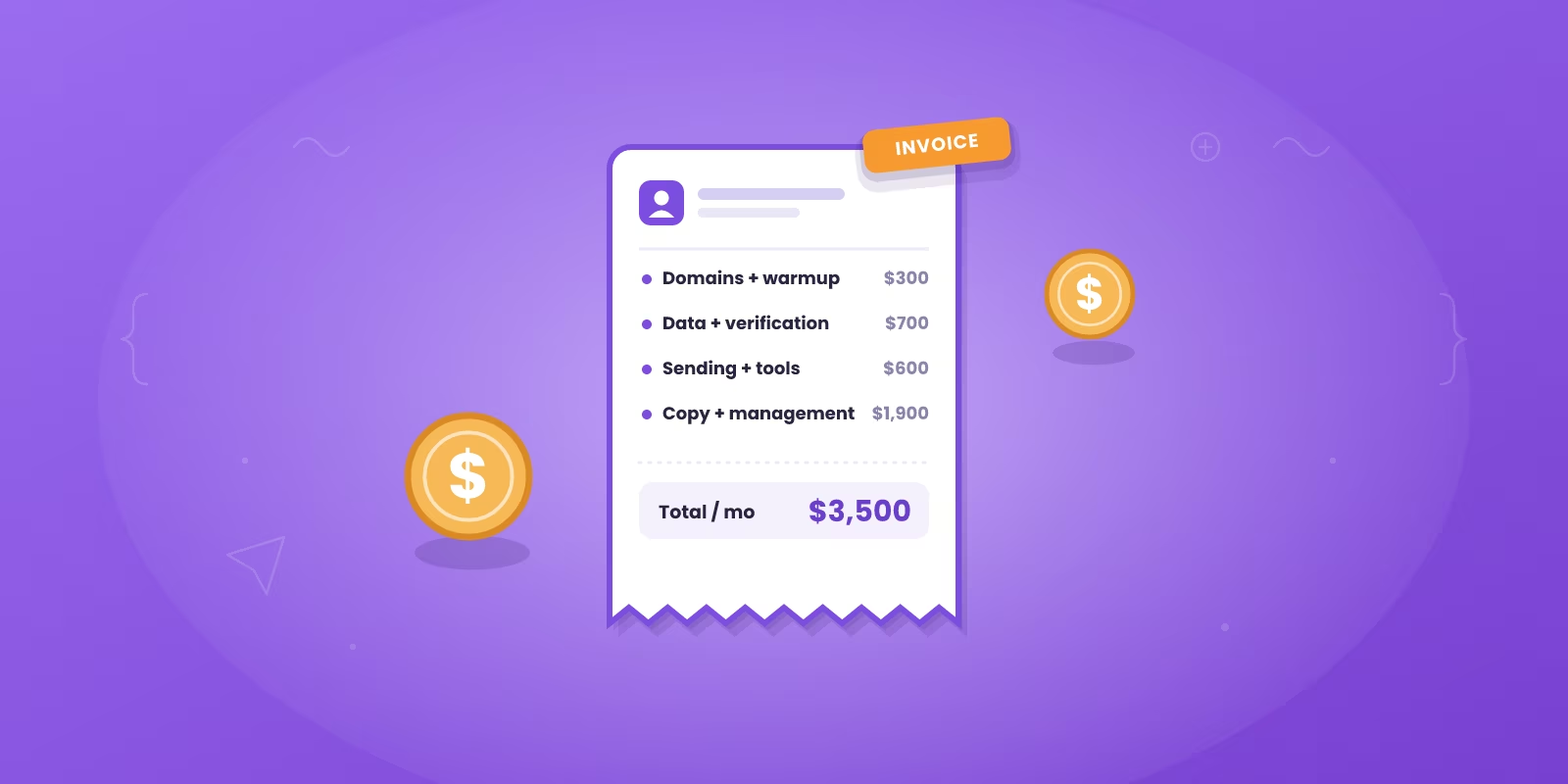
You can get a powerful stack running for less than $400 a month. Here is a lean but effective setup:

  • LinkedIn Sales Navigator: Your foundation for building lists of target companies and people, starting around $99/month.
  • A smart email tool: Something like Smartlead or HeyReach to manage your sequences and protect your domain reputation. Budget about $100/month.
  • Data enrichment platform: Clay is the engine for this whole system. Plans start at $149/month.

The goal is not to buy every shiny new tool. It is about using a select few intelligently. The real investment is not just the software cost. It is the focused time you put into defining your ICP and building the workflows. When you compare this to an SDR's salary or thousands burned on ads that do not convert, the ROI becomes clear very quickly.

How do I know if a buying signal is actually reliable?

You test it. The only way to know if a signal, like a company hiring for a new sales director, actually translates into meetings is to run a small, focused campaign targeting only that trigger. Forget what a blog post told you. Trust your own data.

Isolate one signal at a time. Run a test with 100 contacts for your "now hiring" segment. Then run a separate test for a "recent funding" segment. After a couple of weeks, look at the positive reply and meeting booked rates.

The most reliable signals are the ones that consistently produce meetings for your business. After a few small tests, you will have hard data on which triggers predict real intent for your specific product.

How often should I update my ICP and segments?

Your ICP should never be a static document. Plan for a formal review and update every 6-12 months, but you should be informally checking in on it constantly. Markets shift, new competitors emerge, and your ideal customer profile has to evolve with them.

Every time you sign a fantastic new client, circle back and feed their characteristics into your ICP. What made them such a great fit? And every time a campaign bombs, do a quick post-mortem. Was it bad data? Was the messaging off? Or was the segment itself just a dead end? This constant feedback loop is what keeps your targeting razor-sharp.

Think of it as a living document, not a project you finished last quarter.

Can I do this without hiring an agency?

Absolutely. Everything in this guide is achievable in-house, provided you have someone with the right mix of technical skill, focus, and time.

But it is a trade-off. Running a high-precision outbound system is a full-time job if you want to do it right. It is a constant cycle of data management, copywriting, and campaign monitoring.

Many founders and small teams quickly realize it is more efficient to hand this function to a specialist. The real question is not "Can we do it?" but "Is this the absolute best use of our team's limited time?"

Thibault Garcia
Founder
I’ve spent the past 11 years working across sales and growth marketing, helping businesses build predictable pipeline. My focus is on lead automation, lead generation, LinkedIn optimisation, sales funnels, and practical growth systems. I’ve worked with 500+ businesses on improving their revenue operations, and I enjoy breaking down what consistently works in outbound, positioning, and building repeatable growth.
 
class SampleComponent extends React.Component { 
  // using the experimental public class field syntax below. We can also attach  
  // the contextType to the current class 
  static contextType = ColorContext; 
  render() { 
    return <Button color={this.color} /> 
  } 
} 

Get more meetings with the people who matter, 100% done for you.
Get Started